
Want to learn more about the metrics I use in tracking the metagame? You can find an explainer here.
It’s practically inevitable.
Spellstutter Sprite is back on top of Pauper.
The past two weeks of Weekend Challenges had various decks featuring the Lorwyn standout rise to the top of the standings. This should not be a shock to anyone as Spellstutter Sprite is one of the best Pauper cards of all time. What is remarkable is how often history repeats itself in the format. New decks will emerge to upend the metagame, often displacing a Spellstutter Sprite deck only for the faerie to rear its wings again a few weeks down the line.
Spellstutter Sprite is synonymous with assuming the control role in Pauper. It is two-for-one that has only gotten better over time as the overall mana curve of the format trends lower. It can disrupt opposing game plans before becoming a clock in its own right (albeit a very slow one) and helps to enable other card advantage engines (mostly Ninja of the Deep Hours). While the Sprite is at its best with additional Faerie support it has occasionally shown up in decks where it is the only one of its kind, leveraging its stopping power in decks such as Familiars to provide another angle of interaction.
The biggest barrier to Spellstutter Sprite’s effectiveness is the nature of the metagame. As new cards are introduced and strategies are being sussed out, proactive decks tend to have an edge. Control decks in Pauper lack the overwhelming hammers that may benefit them in other formats. The format’s catch up mechanisms are a bit behind the curve and simply accruing cards is a risky proposition when you’re potentially facing down a lethal onslaught on turn four. But as things start to settle and new threats emerge, Sprite decks can start to figure out the best ways to blunt these assaults, survive and then thrive.
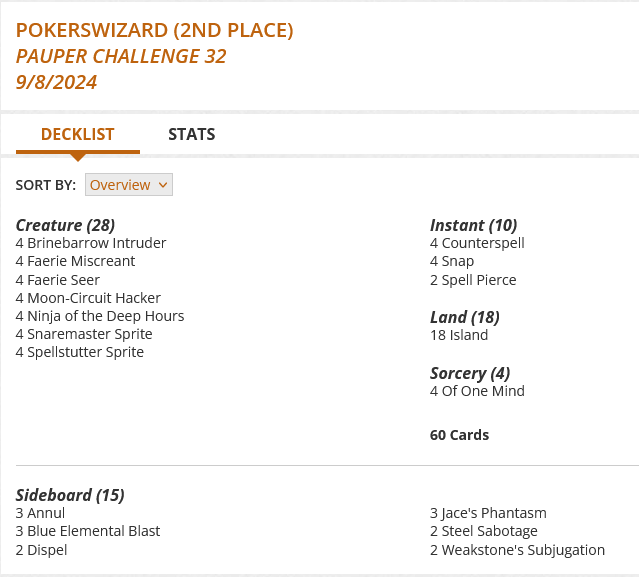
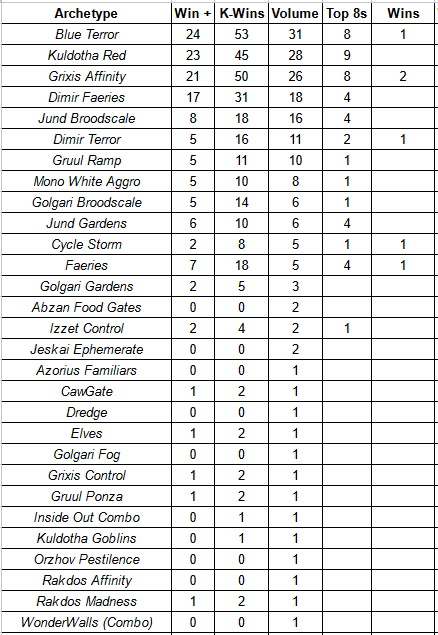
Last week saw the reemergence of traditional Mono Blue Faeries. One of the longest tenured strategies in Pauper, Faeries emerged from Delver of Secret decks after the first Modern Horizons gave the format Faerie Seer. No longer “burdened” with Delver, the deck was able to load up on Faeries to increase the potential gets for Spellstutter Sprite. That the deck came back is only surprising in that more recently Sprite has been paired with red or black for the ability to clear the board of threats. The big change here, however, is Sadistic Glee. A one mana card that has the capacity to end the game, Glee is susceptible to removal to be sure but the various Basking Broodscale decks have a plan for that in the form of Tamiyo’s Safekeeping or Snakeskin Veil. Broodscale combo decks have also been leaning on Duress to make sure the coast is clear and wouldn’t you know it, Sprite is immune to the black spell. Over the past two weeks Faeries pulled in a very respectable 0.47 Adjusted Meta Score Above Replacement and while it only had 2.6% of the Top 32 metagame, it improved upon this with 4.54% of the Winner’s Metagame.
But let’s dive deeper. Over the August 30-September 1 weekend Faeries did not have any Top 32 appearances. In other words all of its results came from the September 6-8 weekend where it had an aMSAR of 1.05 (the best score on the weekend) with a 9.03% share of the Winner’s Metagame over 5.21% of the Top 32 metagame. Put another way, in the span of one weekend Faeries not only put itself back on the map, but is climbing back to the upper tier of the metagame.

What about the other Spellstutter Sprite deck? A hybrid of Murmuring Mystic Dimir Control and old school Dimir Faeries has emerged. Lumped together with traditional Dimir Faeries in my tracking, this deck is not as tempo oriented as previous builds and leans harder on the control side of things. Instead of relying on Faerie Miscreant or Faerie Seer to improve upon Spellstutter Sprite, it goes with Sneaky Snacker. This build wants to keep the board clear an eventually overwhelm with either Mystic or Thorn of the Black Rose. Over the past two weeks these decks have an aMSAR score of 0.52 and have 10.65% of the Winner’s Metagame (compared to 9.38% of the Top 32 meta).
These decks are emerging as contenders in the format but currently have to contend with the top three decks of the last two weeks: Blue Terror (aMSAR of 0.99), Grixis Affinity (0.99), and Kuldotha Red (0.80). Three of the top five decks are leaning on Counterspell strategies which could create an opportunity for Glint Hawk builds to come back to try and out-grind the blue mages if they can also solve for Broodscale Combo. And on the lizard front I would also anticipate more decks leaning on Mesmeric Fiend for their disruption as opposed to Duress.
I want to take a moment to thank all my Patrons I am going to do my level best to keep providing you with the kind of content that brought you here in the first place. If you are interested in supporting my work, rewards for my Patreon start at just $1.
Can’t make a commitment to Patreon? I have a Ko-Fi where you can make a one time contribution.
Looking for another way to support my work? Click here for my TCGPlayer affiliate link. Any purchases through the link let the folks there know you like my content!
 NerdtotheCore