
Want to learn more about the metrics I use in tracking the metagame? You can find an explainer here.
Now that the school year has started (or rather, that New Student Orientation has ended), I hope to be able to return to a more regular posting cycle. My gastroenterologist tells me that being regular is a good thing. He also tells me I’m full of…
Anyway.
As I discussed last week, Bloomburrow season feels much more like an extension of Modern Horizons 3 than its own entity. A look at my latest Power Rankings highlights that despite a new set of cards the current state of things is largely defined by what has come before. Today I want to dive a little deeper into the stats and try to suss out a bit more information that did not quite make it into my other articles.

Gruul Ramp has been the most popular deck this season with 11.98% of the Top 32 metagame and 12.5% of the calculated Winner’s Metagame. These numbers are far from gaudy as in past seasons one could reasonably expect the top decks to take down north of 15% of the Winner’s Meta. It’s Adjusted Meta Score Above Replacement is a healthy 0.98, placing its performance firmly above average. But the story of this strategy is one of mild decline.
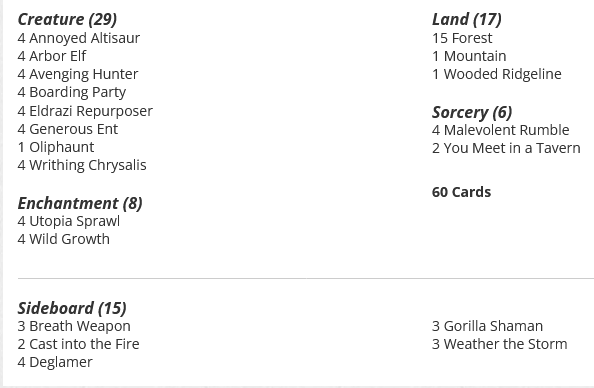
It led the pack in the first two weeks of the season with aMSAR scores of 1.17 and 1.29 before underperforming in week three with a score of -0.23 before bouncing back last week with a 0.16. All told this appears to be the story of a deck that was able to attack an underprepared metagame. Once people got wise the deck came back to earth. Already we have seen some players move back towards Mwonvuli Acid-Moss (but not Thermokarst) as another way to leverage the mana bump from Writhing Chrysalis.

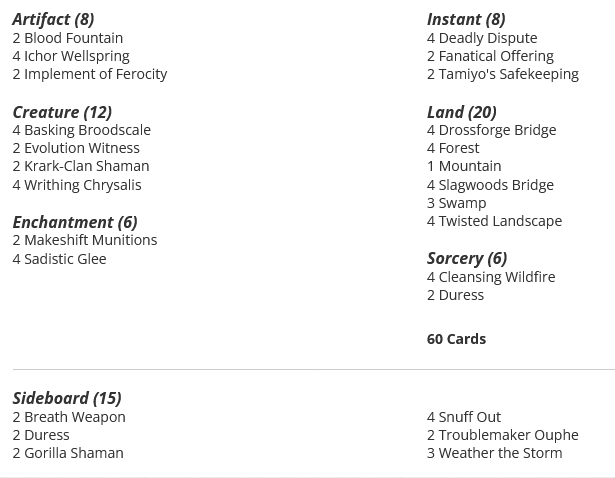
It has become impossible to talk about Pauper without discussing Grixis Affinity. After the Monastery Swiftspear ban, Grixis Affinity emerged as the de facto best deck in the format. While it alone does not define the metagame, its position as the premier control deck puts some limits on what can be done in the format. The Modern Horizons 2 Bridges tie all of Grixis’ synergies together, providing amble fodder for the format’s darling board wipe Krark-Clan Shaman. As someone who has been playing Pauper for nearly two decades (that sound you hear are my knees grinding into dust) it is both wild and awesome. The current tech is to pair it with Toxin Analysis to take out everything on the ground and gain a bunch of life.
Neat.
Grixis started off slow, going from an aMSAR of 0.14 before jumping to 0.81 and 0.91 in Weeks 2 and 3. Last weekend it took a leap to 2.09 (which was somehow only good for the second best showing), ending the last month with a 1.26, a full 0.28 better than Gruul Ramp. With 11.72% of the Top 32 metagame and 13.77% of the Winner’s Meta, Grixis Affinity is once again setting the pace for Pauper.
All of this is before we get to the Eldrazi in the room: Broodscale combo. It’s only recently that the builds are starting to settle with two main camps emerging: a relatively creature light dedicated combo Golgari build and a more midrange Jund execution of the strategy. Regardless, the decks win the same way – generating an unbound number of tokens and colorless mana thanks to Basking Broodscale and Sadistic Glee. The spout might be different, but the machinations bear more than a passing resemblance.
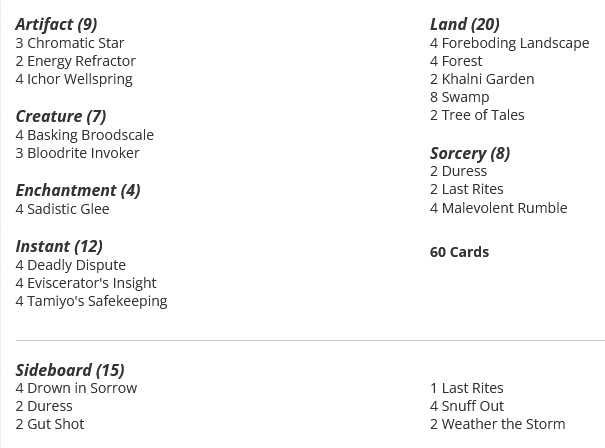
Given that these are two distinct archetypes, their aMSAR scores are split. Needless to say they have both consistently performed at the average or above, with Golgari Boodscale netting a four week score of 0.66 while Jund is just behind at 0.6. Comparing this macro strategy to the rest of the field, at least at a glance, means utilizing a combined Winner’s Meta share. Broodscale Combo start at a combined 16.8% of the Winner’s Meta, moving to 20% in Week 2, down to 16.44% in Week 3, and finishing at 20.28% in Week 4. Looking at the entire month, Broodscale Combo accounted for 18.23% of the total Top 32 metagame and 18.18% of the Winner’s Meta.

So far we’ve discussed ramp, control, and combo. The aggressive deck I want to highlight should not be a shock to anyone in that it is Kuldotha Red. With an aMSAR this season of 0.52 thus far and 8.31% of the Winner’s Metagame (which is largely in line with the 8.33% of the Top 32 metagame), Kuldotha Red has fallen back in the metagame just a bit. Overall the format has gotten more powerful and as such the stagger strength of the deck does not appear to be as daunting. There has been some evolution in the archetype with a few pilots opting to move into a move Goblin heavy build- Goblin Grenade has become a baseline inclusion but some players have decided to further empty the warrens for cards like Goblin Sledder.
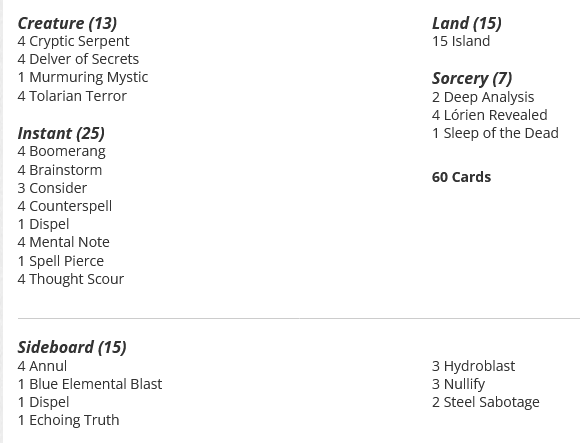
Finally I want to take a moment to talk about Blue Terror. The strategy is currently third in aMSAR score at 0.73 and has 10.4% of the Winner’s Meta. Counterspell remains a fantastic card and Blue Terror is one of the better shells to leverage the card. Tolarian Terror can end games in short order which makes it a well suited threat to capitalize on the tempo gained by countering a key spell. Like other strategies these builds adjust from week to week, moving from Boomerang to Deem Inferior to other bounce spells in an effort to find the best path to victory.
Overall, Pauper appears to be in a good place. While there are decks that are clearly in a class of their own, no one of them are so good as to make picking a divergent strategy a clear mistake. In practice these six* archetypes represent almost 61% of the Top 32 metagame and just over 63% of the Winner’s Metagame. Compare this to season’s past where specific archetypes would easily chew up north of 20% of both shares. Pauper is experiencing a power surge at the moment – a shock tot he system – and it might take a while for the other strategies to catch up. I for one am excited to see what Duskmourn has to offer the format, provided it doesn’t take the shape of a jump scare.
I want to take a moment to thank all my Patrons I am going to do my level best to keep providing you with the kind of content that brought you here in the first place. If you are interested in supporting my work, rewards for my Patreon start at just $1.
Can’t make a commitment to Patreon? I have a Ko-Fi where you can make a one time contribution.
Looking for another way to support my work? Click here for my TCGPlayer affiliate link. Any purchases through the link let the folks there know you like my content!
 NerdtotheCore
I would like to see stats on the long-term price trends of Pauper cards/staples and your recommendations on when and what to buy, as some cards fluctuate in value/tixes.
LikeLike
Can you reply to me with your Twitter/X Handle so I can send you your code?
LikeLike
I’d be interested in seeing the stats for what decks, if any, overperform in leagues vs. challenges and see your take on what might cause that.
LikeLike
Can you reply to me with your Twitter/X Handle so I can send you your code?
LikeLike
Decks can vary significantly within archetypes. We need Moneyball-type analysis of individual cards, to really understand what is going on. Essentially what is the wins-above-replacement (WAR) for Galvanic Blast, for example. That would be very informative.
And then, on top of that, what is the observed diminishing marginal-WAR of having 4 copies vs 3, 2,1. For example, a card like Duress probably has a good WAR as a one-of or two-of, but then would drop significantly with more copies.
LikeLike
Can you reply to me with your Twitter/X Handle so I can send you your code?
LikeLike
I know it’s been a while, but if you still have a code: handle is @mindsovertime
Get verified
LikeLike
I’d be interested to see your opinions on a lack of a ban to pauper this ban rotation, and few comments (that I can find) from the PFP. I don’t think anything is in desperate need of a ban, but keeping an eye on chrysalis and broodscale wouldn’t be a shock to me.
LikeLike
Can you reply to me with your Twitter/X Handle so I can send you your code?
LikeLike
Matchup matrices would be really cool to see. Also a compilation of how many copies of a given card top16s/32s a challenge over a given period, just to track what staples are seeing more play set by set.
LikeLike
Can you reply to me with your Twitter/X Handle so I can send you your code?
LikeLike