
Want to learn more about the metrics I use in tracking the metagame? You can find an explainer here.
July is a weird time of year for me. It’s the only month in the summer where my family can really take a vacation. In case you didn’t know, in my day-to-day life I run a campus center at a college and work closely with New Student Orientation. As a result August is the busiest time of year for me at work. Combine this with my child’s school schedule and we get a relatively narrow window for some well earned rest and relaxation.
Of course that’s hardly the case. I love vacation but coming back to a mountain of work is far from ideal. Combine that with some less than ideal travel conditions on our drive home – including a fender bender (we’re all fine!) and a sick kid (their car seat is not!) – and you get delays in publication.
So that leads me to today. We are two weeks into Bloomburrow season, which in practice is more of an extension of Modern Horizons 3 season. This is not a knock on Bloomburrow, a set that I am excited for in other formats. The issue with the latest release is not the overall power level but where that power is concentrated. Bloomburrow is a set heavily built on internal synergy and as such the commons are meant to support that need. Removed from that context a card like Intrepid Rabbit is not a payoff for Rabbit and Mouse decks, but rather a less than ideal payoff for aggressive Kor Skyfisher decks.
Compare this the Modern Horizons 3. The cards are individually powerful to be sure, but they also intentionally have synergy with cards from Magic’s long and storied history. Writhing Chrysalis works fine on its own but pair it with other Eldrazi and you get a real stat monster. Refurbished Familiar works well in an environment with reasonably costing artifacts but shines in one lousy with cheap and free trinkets. Malevolent Rumble just works if you put it in a green deck.
But still we have new additions to the card pool and so the season has turned. With that in mind let’s take a look at the first two weeks of Bloomburrow season.

These numbers represent the first six challenge Top 32s of Bloomburrow season and one thing to note is the diversity in the most popular archetypes. Yes, Grixis Affinity is still chugging right along with 13.54% of the Top 32 metagame, but other macro archetypes are right there with the Machine, if not exceeding its volume.
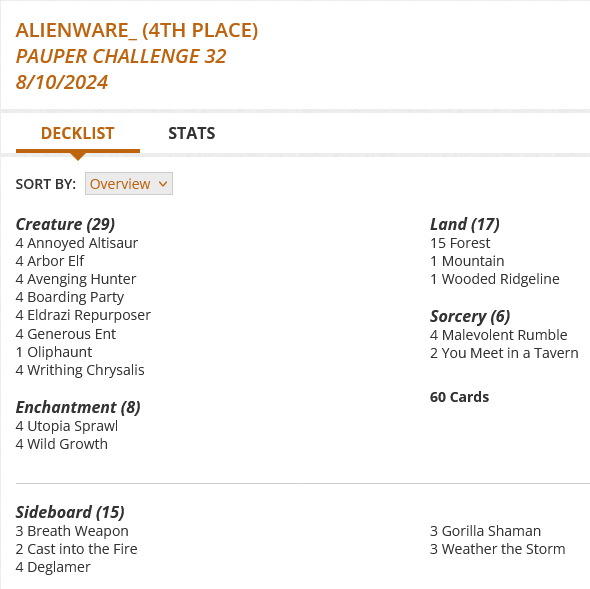
When I say “macro” archetype, in this instance I am not talking about the big buckets like aggro, control, midrange, and combo. Instead I’m using it in this specific instance to talk about decks based around somewhat similar cores and gameplans. A perfect example of this is Gruul Ponza and Gruul Ramp. These two decks have a lot in common, starting with their acceleration package of Arbor Elf and Utopia Sprawl. They both want to accelerate to a dominating endgame but Ponza as has a mana denial angle of attack and, until recently, was the more dominant execution of this core. Clearly that has change in recent weeks but Gruul Arbor Elf decks have made up 19.28% of the Top 32 metagame.

We can see something similar in Tolarian Terror decks. While Blue Terror, Dimir Terror, and Izzet Control all have different executions, these decks all push towards an endgame where they have the biggest threat left on the table. The biggest difference is how they are clearing a path. Combined these decks make up 23.44% of the Top 32 metagame.

Wrapping up this group there’s Basking Broodscale combo. These decks come in two main camps – Golgari and Jund – but there’s a massive amount of variety, especially when it comes to ending the game. Still they all revolve around the same unbound loop of Basking Broodscale and Sadistic Glee providing an endless supply of Eldrazi Spawn, +1/+1 counters, and colorless mana. Combined these archetypes take up 18.76% of the Top 32 metagame.
How does this translate to the Winner’s Metagame? Tolarian Terror decks lead the way with 21.3% of the Winner’s Meta share with Gruul Arbor Elf not far behind at 21%. Broodscale combo is next up with 18.37% with Grixis Affinity outside a medal finish at 12.63%. Again this pulls from a small sample size but right now Pauper centers around who can keep their big threats alive. It follows then that low-restriction removal spells has seen an uptick in play. It also makes sense that Elves has made a comeback.
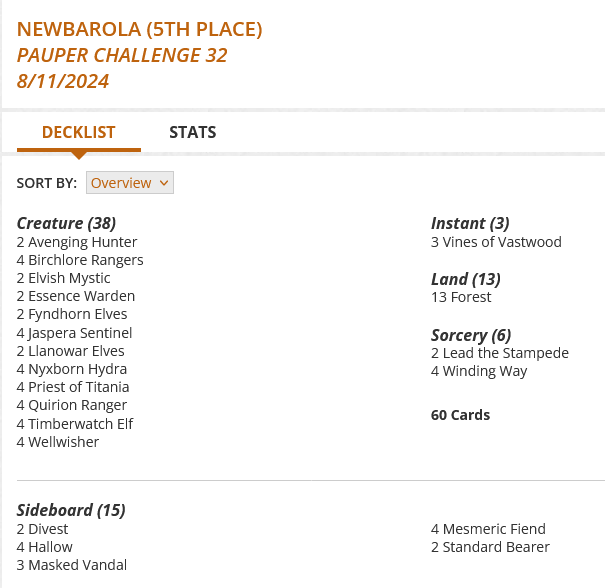
Elves is a deck that, by all accounts, should struggle in Pauper. The bevy of efficient sweepers has kept the pointy eared army at bay for years at this point. But going wide has its advantages in a world full of point removal. The biggest innovation as of late is a mana sink that can win the game on its own in Nyxborn Hydra. Now Priest of Titania can do a fairly solid Timberwatch Elf impersonation, for at least one turn.
The metagame is still settling but moving forward I would want to ensure I have a way to stop Basking Broodscale while also holding Tolarian Terror and Writhing Chrysalis at bay. And this is to say nothing of being able to stop a horde of elves. A deck that can resolve a Pestilence early could go far, if it has the ability to follow that up with cards like Extract a Confession.
I want to take a moment to thank all my Patrons I am going to do my level best to keep providing you with the kind of content that brought you here in the first place. If you are interested in supporting my work, rewards for my Patreon start at just $1.
Can’t make a commitment to Patreon? I have a Ko-Fi where you can make a one time contribution.
Looking for another way to support my work? Click here for my TCGPlayer affiliate link. Any purchases through the link let the folks there know you like my content!
 NerdtotheCore
One thought on “The First Two Weeks of Bloomburrow”