
Want to learn more about the metrics I use in tracking the metagame? You can find an explainer here.
Some may find the image that comes next a bit uncomfortable. Don’t say I didn’t warn you.
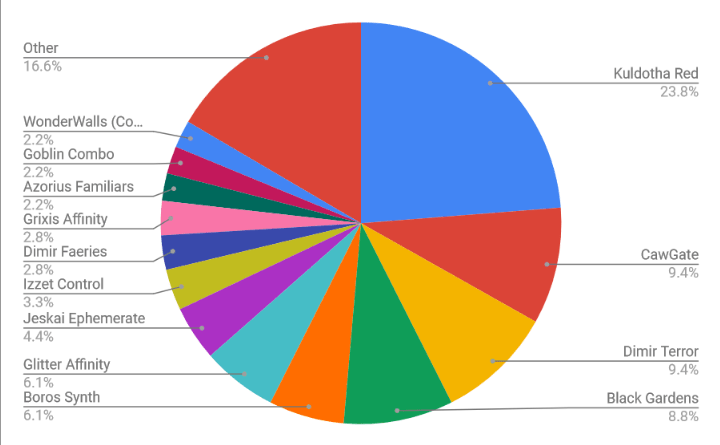
This chart represents the overall Challenge metagame for the weekend of February 24-25. Out of 181 decks that entered one of the three challenges, 43 were Kuldotha Red. On the surface this does not look great but as we dive deeper into the numbers things are not looking quite as dire. As long as Magic Online has been around, low to the ground assertive decks have been somewhat over-represented in tournaments due in part to their low access barrier but also how quickly than can finish games. Considering that the new Sunday structure does encourage double-queuing (that is entering two tournaments at once), the return on investment for Kuldotha Red (both in entry fee, time spent playing, and cognitive load) has the potential to be far greater than other, potentially better, deck choices.
What do I mean by this? Well, Kuldotha Red held largely true to its overall presence in the Challenges by clocking in at 21.88% of the Top 32 metagame. Given this the two Top 8 finishes are also largely in line with what could be expected. Yet when it comes to winner’s metagame share Kuldotha Red tanked hard, down to 14.30% which is only good enough for third best on the weekend. When looking at Adjusted Meta Score Above Replacement Kuldotha Red came away with a paltry 0.13 – fifth best on the weekend. Over the weekend Kuldotha Red had an average adjusted Win+ ratio of 0.29, which tells the story of a deck that can make Top 16 but trends to be just on the outside. It also pulled in a 0.9 adjusted K-Win ratio, which paints a similar picture.
Decks are adjusting to the new speed of Kuldotha Red and are built to handle it, either through maindeck or sideboard options. At the same time the inherent strength of the archetype means that sometimes it will just get there. In other words it continues to be one of the defining pillars of the Pauper metagame but is a far cry from the dominant force it was prior to the Monastery Swiftspear ban.
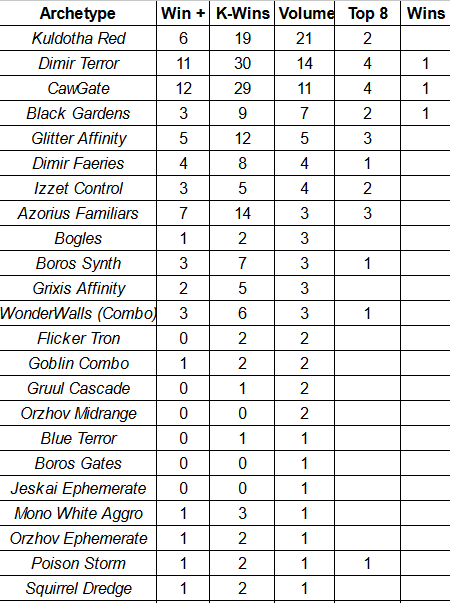
As for which deck had the best weekend overall it’s a tossup between CawGate and Dimir Terror. CawGate had the better aMSAR with 1.83 compared to Dimir Terror’s 1.49, but Terror came out ahead in winner’s metagame, taking down 16.71% while CawGate finished with 15.98% of the winner’s share. Trying to figure out which of these strategies was the best on the weekend is really going to come down to splitting hairs but if I had pick one it would be CawGate, which improved more on its Top 32 metagame share when contrasted to the winner’s meta.
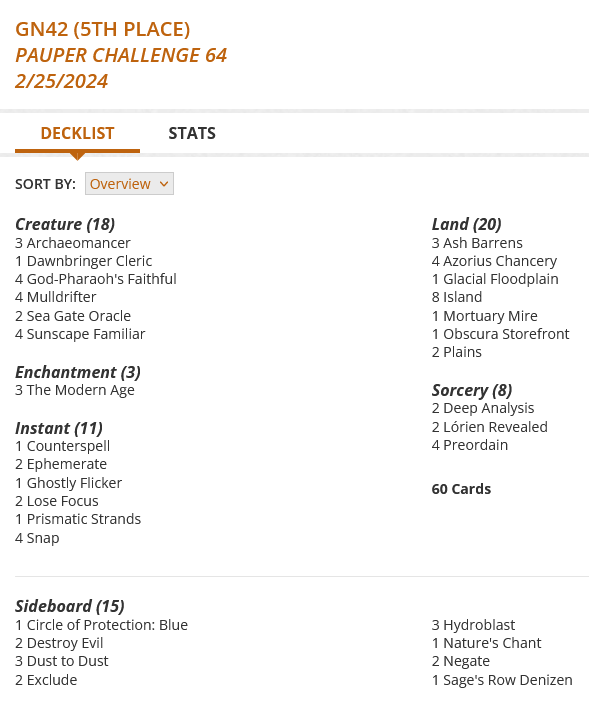
Azorius Familiars also had a fantastic weekend (the above list went 7-0 in the Sunday Challenge before falling in the Top 8). The strategy was only 2.21% of the overall Challenge metagame but jumped to 3.13% of the Top 32 meta. It more than doubled this with a 7.53% share of the winner’s metagame and an aMSAR score of 1.42. There were four Azorius Familiars pilots all weekend and three of them made Top 8. The deck has also been on a tear in tabletop play and has consistently been one of the secret best decks in Pauper. It runs some of the most powerful cards in the format, has a hard to disrupt engine, and a lock down endgame. So what keeps it down?
First is the Magic Online interface. The deck is based on looping Ephemerate to turn the graveyard into a toolbox via Archaeomancer but this takes time and clicks. In paper play you can just announce and reveal the cards but digitally it requires clicks and yields and can put a strain on the clock, as well as your machine. The deck also has a reputation as difficult to pilot but much of this has to deal with the practice needed to click through correctly and not time yourself out. Having played against this deck (and its ancestors) quite a bit over the years I can say from experience that it is not only powerful, but can catch unprepared opponents without a real shot in the game. It is powerful, resilient, and attacks from enough angles that if it goes untargeted it can run roughshod.
Let’s focus on this for a moment. Kuldotha Red was 23.76% of the Challenge metagame while Azorius Familiars was 2.21%. Kuldotha Red was 21.88% of the Top 32 metagame; Familiars was 3.13%. In no world does it make sense to over-prepare for Familiars when other decks are as popular as they are. The kind of hate needed to keep Familiars down – graveyard exile, exile based removal, and mana denial – are not necessarily good against rest of the format (outside graveyard hate). Familiars thrives in part because it can sidestep the metagame in a way the core players cannot. Yet if you wanted to build a deck that beat Familiars you absolutely could, without giving up too much against non-aggressive builds.
And therein lies the rub. When beatdown is as popular as Kuldotha Red is now Familiars can step in and sweep up accolades. The same is true for any deck that has clear weaknesses – when other players have to simply survive this engine based builds can thrive. If Familiars were to ever get as popular as other options it is reasonable that specific interaction would rise up, either in maindecks or sideboards, to constrain the threat. For now it remains a good choice in a field of people simply trying to get out of burn range.
There are a few other things that stood out last weekend, namely the lack of Jeskai Glitters. While Glitter Affinity had a solid showing the splash-red version of the deck was nowhere to be found in the winner’s metagame. I don’t expect this to hold true moving forward but it is interesting to note. The sharp decline in Jesaki Ephemerate decks, after last weekend’s strong performance, also caught my eye but that might be related to people trying to replicate success without adjusting their builds.
Moving into next weekend I would focus on picking the right removal for the job. Dimir Terror and CawGate are not going anywhere so packing the right answers to these, while not giving up ground to little red creatures, is going to be a key to success. Given the way things are working out it would not shock me at all to see Mono-White Aggro sidestep removal entirely and crash in for victory on the back of some copies of Guardians’ Pledge.
I want to take a moment to thank all my Patrons – both old and new. I am going to do my level best to keep providing you with the kind of content that brought you here in the first place. If you are interested in supporting my work, rewards for my Patreon start at just $1 and every little bit helps.
Can’t make a commitment to Patreon? I now have a Ko-Fi where you can make a one time contribution.
Looking for another way to support my work? Click here for my TCGPlayer affiliate link. Any purchases through the link let the folks there know you like my content!
 NerdtotheCore