
I use a few different metrics when looking at the Top 32 metagame. The first is just Raw Volume. The second is Win+, which takes the sum of all wins at X-2 or better in the Swiss and assigns a score; Win+ is helpful in measuring a deck’s Swiss round performance. K-Wins takes all of a deck’s wins and subtracts its losses, Top 8 inclusive; this helps to give a measure of overall performance. The final pair is call Meta Score and Meta Score Above Replacement, which takes the average of Win+ and K-Win to try and position an archetype against its field. This number helps to provide the most robust image of a deck’s performance.
We are rapidly approaching the end of Lost Caverns of Ixalan season. Before we travel back to Ravnica for Murders at Karlov Manor there will be over two months of data to examine from the current state of the format. Given that the next set does not look to have the potential to upset the apple cart this information could prove helpful in understanding how to prepare for the weeks ahead. But that must wait for the next series of Challenges to conclude. For today we are going to be looking at the Pauper Challenge metagame for the weekends between January 6-7 and January 27-28. In that span there were 500 players who entered one of the Magic Online Challenges. The chart below tells us how their deck choices broke down (with a 2% the threshold for making cut):
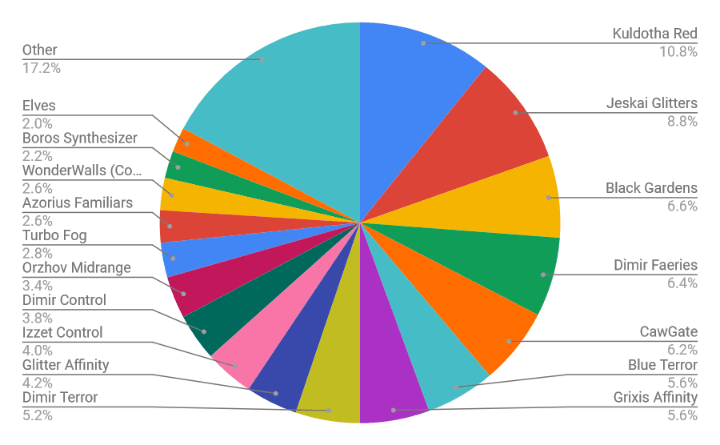
Now to be clear this also includes players who signed up for the tournament but did not play a match, which is a thing you can do apparently. So let’s get one thing out of the way: Galvanic Blast is the defining removal spell in Pauper. This should not be a shock to anyone who has been following Pauper for the past year or so, but it is still interesting to see it presented in such a stark manner. The top two decks, which make up almost a fifth of the Challenge field, both lean on the Scars of Mirrodin burn spell which does a fine job of clearing a path or ending the game. If you add in Grixis Affinity and Boros Synthesizer over a quarter of the Challenge metagame are Galvanic Blast decks.
We see this reflected in the other successful strategies. Black Gardens leans into the Initiative as a way to grow Avenging Hunter out of range while Dimir Faeries presents either too many threats or a 5/5 with Ward 2 as their closer. CawGate has the opportunity to lean on Guardian of the Guildpact to reduce the impact of Blast.
What does this all mean? The prevalence of Galvanic Blast puts significant limits on what kind of creatures can see play. Barring a behind that earns the Sir Mix-a-Lot stamp of approval, creatures need to come with enough value to warrant then dying almost instantly. Alternatively if you can present enough redundant pieces (think Elves or WonderWalls) then it is possible to sidestep the point removal.
But how does this match up to the winner’s metagame?
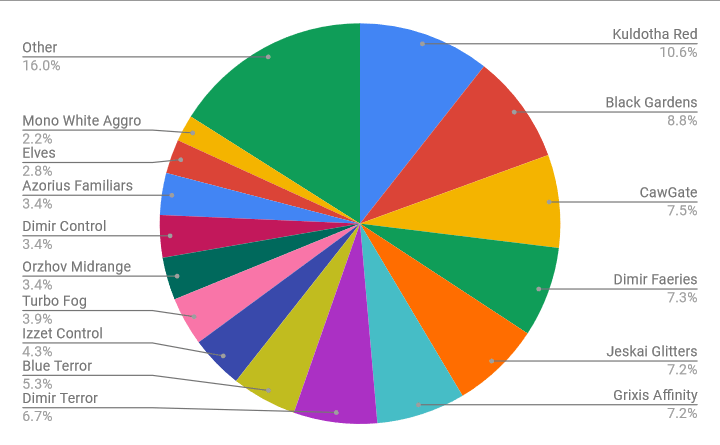
This chart represents the breakdown of each deck in the Top 32 is it relates to Winner’s Meta Share. Each deck is assigned a score based upon their collective overall performance and collective Swiss performance and this chart displays their share of this value. Kuldotha Red remains the most popular deck in the winner’s meta share but Black Gardens and CawGate overtake Jeskai Glitters. These decks can still “just lose” to the best red draws (as do most decks) but it also appears that there’s enough hate for artifacts that can help keep Affinity down. Make no mistake that Affinity is still a major player in the format but the weight of interaction may be having an impact.
Still, the winner’s meta looks to be largely in line with the format at large. There is something reassuring about this in the sense that what you see in the Challenges at large is representative of what is doing well, proportionally. While some league results have skewed towards red (possibly a byproduct of being in the last weeks of a set release cycle, possibly a result of the deck potentially being a little better than the other options), the Challenge meta overall looks reasonable for a non-rotating format.
How does this shake out when it comes to adjusting for presence? Taking into account Top 32 meta percent as well as Swiss and overall performance, the best deck over the past four weeks was Black Gardens with an Adjusted Meta Score Above Replacement of 1.67. This score shows how decks perform against other archetypes, with the average score over the past month coming in at 0.42, so Black Gardens performed that much better than an average deck. Grixis Affinity is next in line with a score of 1.02 with Kuldotha Red coming in third at 0.94. Beyond that CawGate (0.73) and Dimir Terror (0.70) round out the Top 5 archetypes based on aMSAR. It should be noted that four of these five decks are either midrange or control builds.
Taken together the format is defined in many ways by aggressive strategies with reach. The ability to close out games with Galvanic Blast is an animating force in the format. At the same time many top decks have adjusted to be able to handle this line of play to the point where many top performing decks opt for a reactive approach to games and are not just trying to get you dead quickly. Moving into the final week of Lost Caverns of Ixalan and the early days of Murders at Karlov Manor there appears to be a lane where players can get an edge – finding an aggressive deck that goes slightly slower than Red and Glitters while having enough pressure to get in under the controlling decks could prove fruitful.
I want to take a moment to thank all my Patrons – both old and new. I am going to do my level best to keep providing you with the kind of content that brought you here in the first place. If you are interested in supporting my work, rewards for my Patreon start at just $1 and every little bit helps.
Can’t make a commitment to Patreon? I now have a Ko-Fi where you can make a one time contribution.
Looking for another way to support my work? Click here for my TCGPlayer affiliate link. Any purchases through the link let the folks there know you like my content!
 NerdtotheCore