
I use a few different metrics when looking at the Top 32 metagame. The first is just Raw Volume. The second is Win+, which takes the sum of all wins at X-2 or better in the Swiss and assigns a score; Win+ is helpful in measuring a deck’s Swiss round performance. K-Wins takes all of a deck’s wins and subtracts its losses, Top 8 inclusive; this helps to give a measure of overall performance. The final pair is call Meta Score and Meta Score Above Replacement, which takes the average of Win+ and K-Win to try and position an archetype against its field. This number helps to provide the most robust image of a deck’s performance.
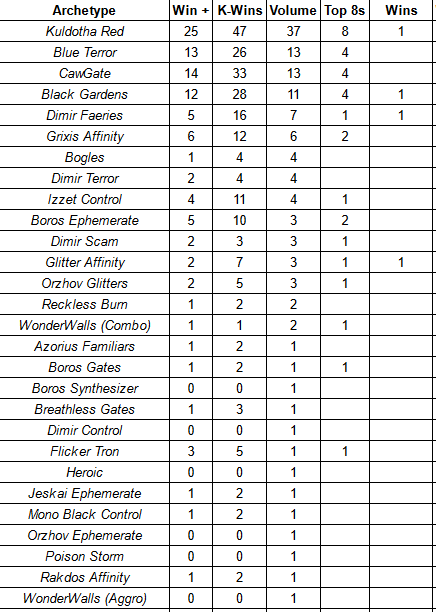
We’re going to be doing something a little different than usual today, if the chart above was any indication. The November 25 and November 26 continue the trends from the previous weekend – lots of Kuldotha Red in the Top 32. 22 decks overall – more than a third of the Top 32 field – with a fully quarter of both Tops awash in Mountains. The chart is not from this past weekend but rather takes the first four challenges from Lost Caverns of Ixalan season.
Looking at this, things appear to be grim. Fully 25% of the Top 8s went to Kuldotha Red – a deck that had more Top 32 finishes than the next two most popular decks combined. Kuldotha Red is also leading the way in raw numbers of Swiss wins (Win+) and total wins (K-Wins). This comes on the heels of a season where red decks took a pretty significant dive before apparently coming back with a vengeance. But what happens when we pull back the curtains a little bit and look at some more advanced metrics?
For this next portion of the post we are going to be discussing decks with at least three total Top 32 finishes, which hovers around the 2% volume threshold.
Win+ measures a decks Swiss performance and given Kuldotha Red’s sheer presence it should dominate in this area, which it does. Adjusting for volume the deck’s Win+ average is 0.68, which is the best mark of qualified decks. By way of comparison a Win+ average of 1 roughly equates to a Top 16 finish and so it can be inferred that Red’s average finish is trending towards a Top 16. The next best mark, adjusted for volume, is CawGate at 0.38.
K-Wins takes an archetypes total wins and subtracts total losses, including the Top 8. Adjusting for volume Kuldotha Red clocks in at a respectable 1.27 – a solid Top 16 finish that isn’t quite 9th on breakers. It is the third best mark in this regard behind CawGate (1.78) and Black Gardens (1.52). While the data set is small this indicates that once these archetypes reach the final rounds of a tournament, the more flexible decks have done better to this point in this season.
The most obvious explanation of this phenomena is that both Black Gardens and CawGate have access to the sideboard tools to keep Kuldotha Red in check while not giving up too much against the rest of the field, while understanding that Kuldotha Red lines up poorly against these two strategies. Of course this leads to the issue that has been prevalent for much of the past year – that it takes an overabundance of sideboard cards to keep Red in line with the rest of the metagame.
There is one more way to look at the decks in question and that is with their adjusted Metagame Score Above Replacement. This takes an archetype’s performance and, after adjusting for volume, compares it to the remainder of the field. Kuldotha red pulls in with a 0.74 score in this regard which is second best behind CawGate (0.89) and just ahead of Black Gardens (0.69).
What does this all mean? Right now not a whole lot. Red has added another gear to it’s game with Goblin Tomb Raider and the rest of the metagame is playing catch up. Red is still setting the pace but you have to prepare for both the quick death Mountains bring and the slow methodical demise of CawGate and Black Gardens.
I want to take a moment to thank all my Patrons – both old and new. I am going to do my level best to keep providing you with the kind of content that brought you here in the first place. If you are interested in supporting my work, rewards for my Patreon start at just $1 and every little bit helps.
Can’t make a commitment to Patreon? I now have a Ko-Fi where you can make a one time contribution.
Looking for another way to support my work? Click here for my TCGPlayer affiliate link. Any purchases through the link let the folks there know you like my content!
 NerdtotheCore