
I use a few different metrics when looking at the Top 32 metagame. The first is just Raw Volume. The second is Win+, which takes the sum of all wins at X-2 or better in the Swiss and assigns a score; Win+ is helpful in measuring a deck’s Swiss round performance. K-Wins takes all of a deck’s wins and subtracts its losses, Top 8 inclusive; this helps to give a measure of overall performance. The final pair is call Meta Score and Meta Score Above Replacement, which takes the average of Win+ and K-Win to try and position an archetype against its field. This number helps to provide the most robust image of a deck’s performance.
Okay folks, before I dive in to today’s post I highly (highly) encourage you to read this post from two weeks ago that goes into a bit more detail about the different metrics I use in examining the Pauper metagame.
Last weekend saw three events on the Magic Online Pauper calendar. Not only were there the regularly scheduled Saturday and Sunday Challenges, but there was also a Pauper Qualifier on Saturday. While I pay attention to every Challenge, Showcases and Qualifiers tend to provide some more robust data. This is because these tournaments tend to have more rounds than a typical challenge which helps to reduce the impact of variance on results. These events also attract a larger audience than the typical Pauper Challenge which can mitigate some of the accepted conventional wisdom in the format. So when an event of this nature has eight different blue decks in the Top 8, and another four in the Top 16, I sit up and take notice.
I don’t want to get too much deeper into this post without getting to the main point, so here it is: blue is back in a big way. While a massive amount of the discourse over the past few months has been about the various red decks packing Monastery Swiftspear, the story of Wilds of Eldraine season to this point has been the steady climb of CawGate and now, the return of Dimir Faeries.
But that’s the end result. Let’s take a look at what has gone on as of late. I think it’s important to start with Kuldoltha Red. This deck has 80 total appearances thus far this season with an impressive 18 Top 8s and two wins. It held a health 1.19 adjusted Meta Score Above replacement for the first four weeks before plummeting to a 0.01 in the second four weeks. It’s aMSAR on the season sits at 0.82.
When I talk about Kuldotha Red I am specifically referring to decks that run Kuldotha Rebirth. Some of these decks are lower to the ground, sticking with one drops while others have incorporated Name Sticker Goblin to their gameplan.


These, a decks like them, have provided a consistent clock to Pauper for months. They hit the board early and can apply pressure while reloading in the middle stages of the game thanks to red’s new suite of card “draw”. Despite their popularity and the amount of digital ink spent on dissecting these builds they have somewhat under performed, especially in Challenges.
So what gives?
The vast majority of online Pauper play takes place in Leagues – five round non-sequential event that have scaling rewards for three, four, and five wins. Leagues are a great way to get in reps with a deck but also a great way to grind for more prizes. If the goal is to play as many leagues as possible to garner the more reward, then red decks make sense since they can breeze through a league and have draws that Just Win. This in turn can impact the way people feel about the format at large, especially if they are running into red deck after red deck in a league. Given that Leagues are one of the best ways to practice a deck for the Challenges it also means that many players come to these tournaments expected red, which in turn has placed increased importance on Blue Elemental Blast and Hydroblast.
This is a very important piece I do not want to get lost: the rise of blue makes sense given the incentive structure of leagues and the nature of red decks. As blue has the best answers to red, the question becomes what is the best blue deck to run.
The answer, it seems, is CawGate. This flexible midrange strategy has been the best performing archetype over the past two months. It has 31 Top 8 finishes in 60 total appearances, with a trio of wins as well. It is the best performing deck in the Swiss rounds, and the best performing deck taking Swiss rounds and the Top 8 into consideration. It has an aMSAR of 1.54 for the entire season (0.44 for the first four weeks; 1.73 for the second four weeks) which is the best mark amongst all decks.

There’s a lot to like about these decks. Sacred Cat and Basilisk Gate can undo several turns of attacking after Prismatic Strands helps you stabilize. The game will eventually end with a flyer or Guardian of the Guildpact that has passed through the Gate. The mana base makes it easy to splash important off color cards (one of the Top 8 decks from the qualifier leaned into green for Centaur Healer, for example) and the result is a deck that can be tuned for a wide variety of metagames.
Is CawGate as good as the numbers indicate? Thus far this season the answer is yes. The deck has enough tools to get it over the finish line and the right mix of interaction to keep pace against the wide gamut of archetypes that can get thrown at it. The mana base also allows it to pack anti-blue cards that other blue decks cannot support.

The numbers on Dimir Faeries are not nearly as impressive as those in the other two decks discussed today. It only has 21 appearances with eight Top 8 finishes and two wins. It had a -0.20 aMSAR for the first four weeks, countervailed with a 0.62 score for the second four weeks for a 0.30 overall score. But if CawGate is the best deck for the season, Dimir Faeries may be the best deck for this moment. Traditionally Dimir Faeries is the midrange control deck that preys on other blue decks. As people go lean on their counterspells with cards like Dispel and Spell Pierce, Spellstutter Sprite shines bright as a way to win stack battles. Dimir Faeries also has several ways to keep cards flowing between Ninjas and the Monarch and enough removal to keep opposing threats off the board. The strategy has only been back in force for two weeks but given how well it has performed in that time (weekly aMSARs of 2.26 and 0.88) I fully expect it to keep putting up numbers.
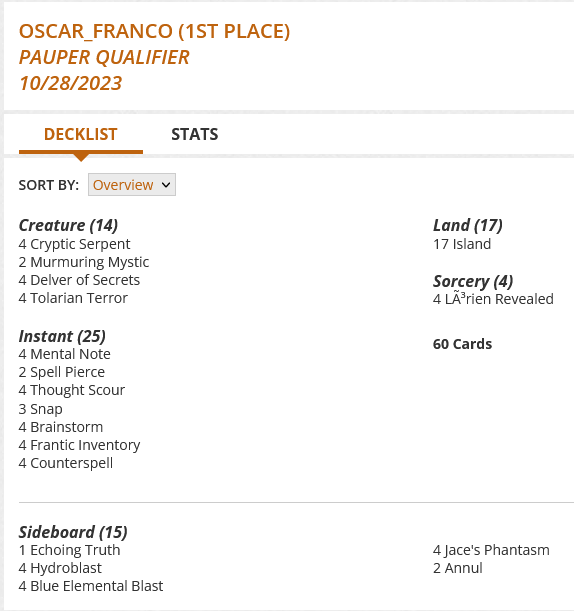
Blue Terror is right behind CawGate in terms of seasonal aMSAR (1.5). With 19 total Top 8 finishes and four wins in 69 total appearances the deck has been a consistent force at the top of the metagame since Cryptic Serpent made its way to common. The deck is lean and has minimal flex slots. Even then, the build above has found the way to be relevant in the ascending control meta with Murmuring Mystic. Mystic has the ability to completely take over control mirrors thanks to its ability to churn out threats. As the number of control decks in the meta rise I anticipate Mystic will be one of the defining cards of the final two weeks of Wilds of Eldraine season.
What do I mean about an ascending control meta? As mentioned previously the prevailing conversation in Pauper as of late has centered on the strength of red decks and how they have forced blue decks to play a bevy of Blasts. Other decks have risen up around these two focal points, including a surge in Golgari Moment’s Peace decks that seek to drawn the game out as long as possible.

These strategies have been marginally successful to this point in part for their ability to take down red decks but also provide enough interaction to stymie the Terror builds and other aggressive strategies like Glitter Affinity, Bogles, or Heroic. But these decks are not able to play control the same way against Faeries since they can simply pick their spots with countermagic for maximium impact. Dimir Faeries, for example, lines up rather well against the above list.
The control decks have reached a point where they can not only reasonably handle the red decks, but they can also deal with the decks that have come to beat up on aggro. In many ways this is a typical Pauper development, with Faeries rising to the top. It is entirely possible that in a few weeks time we will see the return of Boros to the metagame, or perhaps Orzhov Ephemerate will rise up again.
Now when we talk about the format we cannot start with the primacy of Swiftspear. It is easy to point at the results from this weekend and say that blue rose to the top due to its ability to handle red. At the same time, they also had to handle the non-red decks and other blue decks, all while hampered by the dead weight of between four and eight sideboard cards.
How can you approach this metagame? Faeries decks are traditionally week against “go wide” white strategies but these decks have been a step behind in recent weeks. It is not that they have gotten worse but the other decks have gotten lower to the ground and tapping out for Battle Screech isn’t nearly as daunting if the blue deck has its own flying army at its disposal. It could be Electrickery‘s time to shine once again which could translate to a boon for traditional Boros Bully.

I want to take a moment to thank all my Patrons – both old and new. I am going to do my level best to keep providing you with the kind of content that brought you here in the first place. If you are interested in supporting my work, rewards for my Patreon start at just $1 and every little bit helps.
Can’t make a commitment to Patreon? I now have a Ko-Fi where you can make a one time contribution.
Looking for another way to support my work? Click here for my TCGPlayer affiliate link. Any purchases through the link let the folks there know you like my content!
 NerdtotheCore