
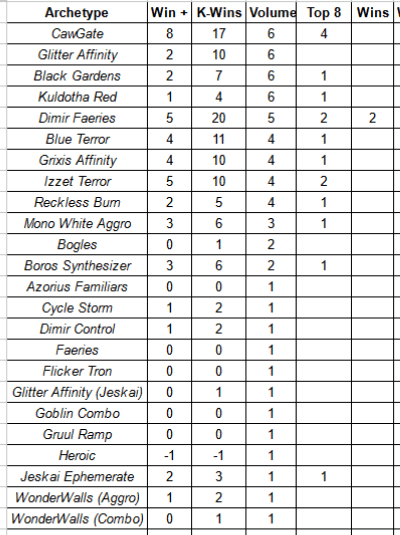
I use a few different metrics when looking at the Top 32 metagame. The first is just Raw Volume. The second is Win+, which takes the sum of all wins at X-2 or better in the Swiss and assigns a score; Win+ is helpful in measuring a deck’s Swiss round performance. K-Wins takes all of a deck’s wins and subtracts its losses, Top 8 inclusive; this helps to give a measure of overall performance. The final pair is call Meta Score and Meta Score Above Replacement, which takes the average of Win+ and K-Win to try and position an archetype against its field. This number helps to provide the most robust image of a deck’s performance.
Any conversation about the last weekend in Pauper needs to start with Beicodegeia’s absurd run as of late. They have taken first (either through an outright victory or an agreed upon split) in seven of the last ten Challenges with four different strategies. During that stretch folks have calculated Beicodegeia’s win rate at around 70%, which borders on obscene. Not only are they a fantastic player, but they also have a stellar read on the metagame.
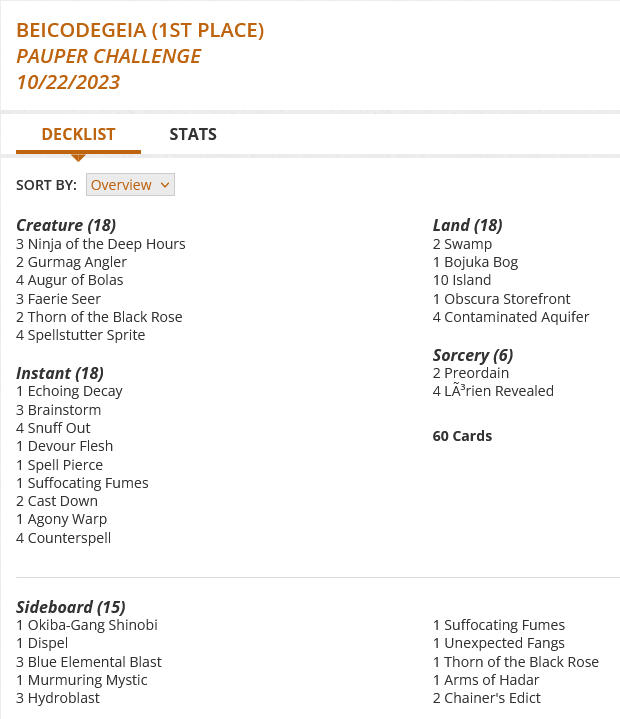
This weekend Beicodegeia took down both Challenges with 74 of the same cards in their deck. The biggest difference was on Saturday they used two copies of Arms of Hadar in their sideboard and on Sunday they cut a copy for Okiba-Gang Shinobi. And this shift is emblematic of the bigger change in the Pauper metagame over the past few weeks.
The driving forces in the metgame for the first portion of Wilds of Eldraine season have been aggressive strategies. Glitter Affinity and Kuldotha Red clearly fall on the aggressive side of the spectrum. Blue Terror is not an aggro deck per se but it is hardly a control deck. Instead it wants to churn to large threats and protect them once they hit the board instead of dragging the game out forever. Three weeks ago CawGate began to emerge as the best deck of the moment and as a result aggressive strategies began to struggle. And now what comes back to roost?
Faeries.
Dimir Faeries is one of the premier “fair” decks in the format and it is well positioned to prey on other control strategies that are trying to beat the beatdown decks. After Counterspell other control decks have started to lean on Dispel and Spell Pierce to round out their interactive suite. And you know what dodges them both? Spellstutter Sprite. Combine that with the ability to see a ton of cards and you have deck primed to prey on the other prevalent “control” decks of the day while packing enough removal to hold its own against aggro. And if the switch from Arms to Shinobi is any indication, control is on the rise while aggro has taken a step back.
The next question that presents itself goes something like this: can this last? Has Pauper again reached a state where aggressive strategies are not at the tip-top of the metagame and are instead merely another good option? Have solutions been found to slow things down enough for other decks and ideas to take hold?
Does it matter?
What I mean is, if the meta is changing at the top but it is familiar faces taking over, is that a good change? This goes to the core of non-rotating formats. In some sense, having Faeries be a viable strategy again is a Good Thing in that having stable staples can provide a sense of security. In another very real way, it can be disheartening to see new gods toppled only for old titans to take their place.
In the micro, next week I would focus on building something resilient that does not fold to Snuff Out (nor need it as a key piece of the deck’s structure). Orzhov Ephemerate could be well positioned as it can match Dimir’s value while playing to the board, but Mono White Aggro could sneak in and find the middle road between lingering aggressive tendencies and the rising tide of control.
I want to take a moment to thank all my Patrons – both old and new. I am going to do my level best to keep providing you with the kind of content that brought you here in the first place. If you are interested in supporting my work, rewards for my Patreon start at just $1 and every little bit helps.
Can’t make a commitment to Patreon? I now have a Ko-Fi where you can make a one time contribution.
Looking for another way to support my work? Click here for my TCGPlayer affiliate link. Any purchases through the link let the folks there know you like my content!
 NerdtotheCore