
I use a few different metrics when looking at the Top 32 metagame. The first is just Raw Volume. The second is Win+, which takes the sum of all wins at X-2 or better in the Swiss and assigns a score; Win+ is helpful in measuring a deck’s Swiss round performance. K-Wins takes all of a deck’s wins and subtracts its losses, Top 8 inclusive; this helps to give a measure of overall performance. The final pair is call Meta Score and Meta Score Above Replacement, which takes the average of Win+ and K-Win to try and position an archetype against its field. This number helps to provide the most robust image of a deck’s performance.
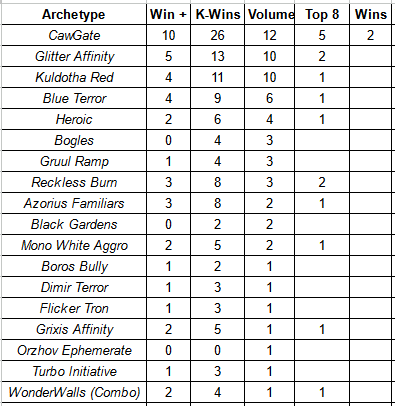
Today I want to make the case that at the current moment CawGate is the best deck in Pauper. To do this I am going to lean on the metrics I use in metagame discussion, specifically adjusted Meta Score Above Replacement. But given that I want to take a few moments to explain exactly what this score represents.
The statistic I have been tracking for the longest (beyond raw volume) is something called Win+. Win+ measures a deck’s Swiss record with a point for each win at X-2 or better. In a six round tournament a 4-2 record is worth 1 Win+ point; in a seven round tournament a 5-2 record is worth 1 Win+ point. The goal of this score is to see how a deck performs in relation to the lowest placing Top 32 deck (with a positive record). This metric only covers Swiss record; K-Wins however is inclusive of Top 8 wins and losses. K-Wins measures a deck’s total wins and subtracts the total losses. Together Win+ and K-Wins gives a broad picture of how well an archetype performs in the abstract.
The next measure is Meta Score, which is contingent on Win+ and K-Win. In fact, it is an average of the two scores; the Meta Score Above Replacement takes the average of all Meta Scores to set a baseline for a weekend and then measures the Meta Score against that average. For example, CawGate had a Meta Score of 1.50 for the most recent weekend while the average of all Meta Scores was 1.53, meaning CawGate’s MSAR was -0.03.
Okay, we’re in the home stretch where we talk about Adjusted Meta Score. Adjusted Meta Score takes the most popular deck by volume and sets it as the baseline. It then takes the a weighted measure of both Win+ and K-Wins (based upon volume) to assign an adjusted Meta Score, and then from there we find the adjusted Meta Score Above Replacement. This provides the best image of how well a deck performed in a given data set against its field
Again, let’s use CawGate from this past weekend as a test case. CawGate had a total Win+ score of 10 with 26 K-Wins. It’s adjusted Win+ for Volume was 0.83; its adjusted K-Win was 2.17. As mentioned it had a Meta Score of 1.50 which is the same as its adjusted Meta Score (CawGate was the most popular deck on the weekend). The average of all adjusted Meta Scores was 0.37 which means CawGate’s adjusted Meta Score Above replacement on the weekend of October 14 and October 15 was 1.13, which was the best score on the weekend.
That’s a lot of words as background as to why today CawGate is my pick as the best deck in the format. Why? It’s aMSAR has been steadily climbing week over week. Here is the progression of CawGate’s aMSAR over the first six weeks of Wilds of Eldraine Season: -0.04, 0.12, 0.22, 1.26, 2.13, 1.13. While the most recent weekend looks like a step backwards it was the best score of an archetype on the weekend.
So what is going on? The earlier weeks of the season were defined by assertive decks like Blue Terror, Kuldotha Red, and Glitter Affinity. CawGate is not the beatdown in any capacity and instead assumes a midrange control role in the metagame. The steady climb seems to indicate that it found the correct configuration to once again assert its position in the Pauper Challenge metagame.
And on some level it makes sense. The strategy is built, in many ways, around leveraging Prismatic Strands to its full potential (if only someone wrote an article on this subject) and leaning on the correct suite of counter magic. Without knowledge of the expected field you cannot select the proper suite of reactive spells. With a more known metagame this task becomes easier.
How should you approach next weekend? I think Gingerbrute is a good place to start as it can completely get around Prismatic Strands’ damage prevention. If you’re looking to go in a more rogue direction there’s Shepherd of Rot. Zombies is a fringe strategy to be sure but as more red decks adopt Lava Dart I want to be on the deck that can run Festering Mummy to shrink opposing 1/1s.
I want to take a moment to thank all my Patrons – both old and new. I am going to do my level best to keep providing you with the kind of content that brought you here in the first place. If you are interested in supporting my work, rewards for my Patreon start at just $1 and every little bit helps.
Can’t make a commitment to Patreon? I now have a Ko-Fi where you can make a one time contribution.
Looking for another way to support my work? Click here for my TCGPlayer affiliate link. Any purchases through the link let the folks there know you like my content!
 NerdtotheCore
One thought on “October 14-15 Pauper Weekend Recap”