
I use a few different metrics when looking at the Top 32 metagame. The first is just Raw Volume. The second is Win+, which takes the sum of all wins at X-2 or better in the Swiss and assigns a score; Win+ is helpful in measuring a deck’s Swiss round performance. K-Wins takes all of a deck’s wins and subtracts its losses, Top 8 inclusive; this helps to give a measure of overall performance. The final pair is call Meta Score and Meta Score Above Replacement, which takes the average of Win+ and K-Win to try and position an archetype against its field. This number helps to provide the most robust image of a deck’s performance.
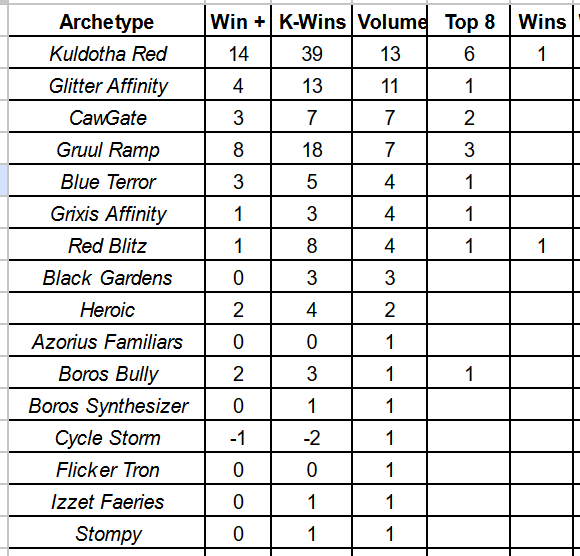
Traditionally the earliest part of a metagame cycle favors aggressive decks. When new cards are released into the wild it is far easier to present threats than to have the proper responses. Metagames take time to coalesce around the new environment at which point the more granular decisions can be made. You never want to bring Flame Slash to a Skred fight or be stuck with Dispel when you really wanted Spell Pierce. In that way it is no surprise that Kuldotha Red did well during the first weekend of Wilds of Eldraine season.
But how well did it actually do? We can see the Top 8 numbers – six of the sixteen Top 8 slots went to Kuldotha Red and it won the Sunday challenge. On this metric there is no doubt Kuldotha out performed the field. Digging deeper the numbers are both far less, and far more interesting.
For this we need to look at the Adjusted Meta Score Above Replacement. This score takes an archetype’s total Swiss record and it’s total Win-Loss record and compares it to those same averages for each other archetype, and then adjusts for metagame presence. Last weekend Kuldotha Red had an aMSAR of 1.79 – far and away the best performance on the weekend with Gruul Ramp holding the next highest score of 0.65.
Kuldotha absolutely had a great weekend but it is not giving me too much cause for concern. At the start of Commander Masters season Boros Synthesizer had an amazing first weekend, pulling down an aMSAR of 3.26 with the next best deck (Dimir Terror) clocking in at 0.93. Boros Synth ended the five week season with a respectable aMSAR of 0.67. Now I’m not saying that Kuldotha Red is going to take such a stark dive but it is important to look at these weekends as part of a larger picture.
What does that picture tell us? Taking Kuldotha’s success last season and the first weekend with new cards I would not put too much stock into the results as a long term predictor of anything. I would feel confident in saying Kuldotha Red is not going anywhere for the foreseeable future, but I also doubt it is going to run roughshod every week moving forward.
Here is where we come to the limitations of the Magic Online metagame. The pool of regular Challenge players is relatively static and as such singular results can cause ripples out of proportion with their actual impact. Because of this the metagame can be prone to overcorrection – a bevy a blue decks leads to some maindeck copies of Pyroblast which then leads to people trying to dodge en masse and ta-da.
So what does that mean moving forward? Another overcorrection is likely coming as people react to Kuldotha Red and load up on more anti-red measures. If I were trying to sidestep all of this I would avoid running Mountains and Islands next week and see if I could sneak in a Glistener Elf that has had it’s noble spirit Embiggened.
I want to take a moment to thank all my Patrons – both old and new. I am going to do my level best to keep providing you with the kind of content that brought you here in the first place. If you are interested in supporting my work, rewards for my Patreon start at just $1 and every little bit helps.
Can’t make a commitment to Patreon? I now have a Ko-Fi where you can make a one time contribution.
Looking for another way to support my work? Click here for my TCGPlayer affiliate link. Any purchases through the link let the folks there know you like my content!
 NerdtotheCore