
I use a few different metrics when looking at the Top 32 metagame. The first is just Raw Volume. The second is Win+, which takes the sum of all wins at X-2 or better in the Swiss and assigns a score; Win+ is helpful in measuring a deck’s Swiss round performance. K-Wins takes all of a deck’s wins and subtracts its losses, Top 8 inclusive; this helps to give a measure of overall performance. The final pair is call Meta Score and Meta Score Above Replacement, which takes the average of Win+ and K-Win to try and position an archetype against its field. This number helps to provide the most robust image of a deck’s performance.
Hello again everyone! After a week where my real job took precedence I am back (without a vengeance, I might add)! Rather than go over the individual events I want to take a look at the bigger picture and examine the first four weeks of Commander Masters season. Wilds of Eldraine is right around the corner and that set, while interesting, lacks the punch of the last release. In other words, I would expect the impact of Commander Masters to reverberate for quite some time. This is not meant to be a knock on Wilds, as two of the set’s core mechanics – Bargain and Roles – play right into Pauper play patterns thanks to the way they interact with extra material.
Enough about the not-too-distant future, let’s talk about the now. This analysis is going to focus on the adjusted Meta Score Above Replacement. Roughly speaking this measures how much better an archetype is than an “average” Top 32 finishing deck. The higher the number, the greater the distance from the mean performance. Taken in conjunction with other measures, including Top 8 finishes, we can get an idea of the landscape at the top of the metagame.
There is one final thing of note before I begin: this is the first time during one of these check-ins that not a single archetype tops 10% of the Top 32 metagame in raw volume. The most popular deck (Kuldotha Red) pulls in at 9.38%. There are three other decks with between 8% and 9%, and another three with volume in the 7% range. While this only takes into account a four week span it is a huge step towards a “flattening” at the top of the metagame – something that Pauper has been striving towards for quite some time.
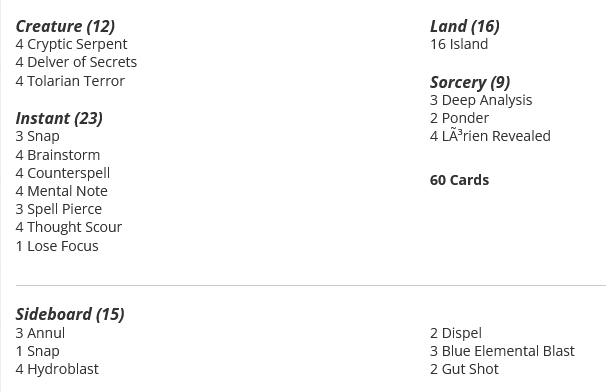
Blue Terror is just that – a terror. The fifth most popular deck (7.81%) it has eight Top 8 finishes, including two wins. It averages a Top 16 finish and when looking at winner’s meta volume sees a jump to 9.37%. Blue Terror is also leading the pack in aMSAR with 1.19. The deck takes the aggressive side of Delver decks of yore while adding large threats like Cryptic Serpent and Tolarian Terror. Churning through the library with cantrips, Terror also plays some of the best countermagic available in Pauper while shaving on lands thanks to Lórien Revealed. The cycle of basic landcyclers from Tales of Middle Earth have completely changed the way mana bases are constructed as they act as land drops early and high impact spells late. Blue Terror is so consistent in part due to its ability to make every land drop while using sculpting to further its game plan.
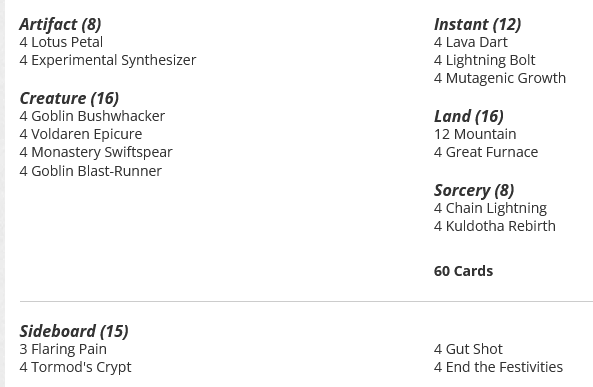
There is little to be written about Kuldotha Red that has not already been recorded in the annals of history. The best red deck Pauper has likely seen, Kuldotha Red is the most popular archetype thus far this season. It’s winner’s volume ticks up to 10.34% and it has seven total Top 8 finishes. It also lags behind Terror with an aMSAR of 1.16. Not much has changed with Kuldotha Red in practice even if certain builds have started to develop. Some players prefer Lotus Petal and Mutagenic Growth while others have leaned into Human typal with Burning-Tree Emissary and Rally at the Hornburg. Regardless, Kuldotha continues to be able to apply pressure early and often, putting a real clock on the Pauper meta.
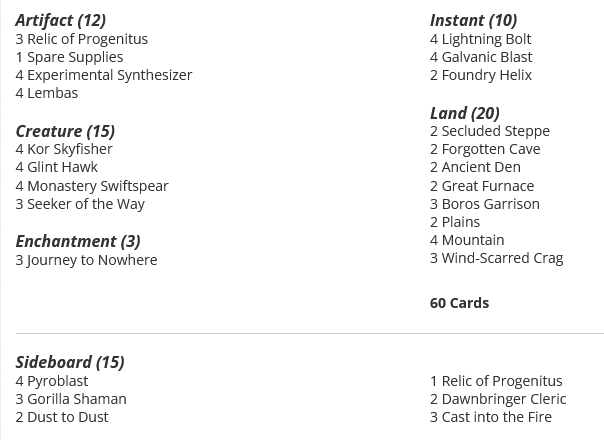
Add white to the mix and you end up with Boros Synthesizer. The deck came on strong with several Top 8 finishes early but has trailed off as of late. Boros Synth has taken down eight Top 8 slots (with a win) with 7.42% of the total Top 32 volume. It’s winner’s meta volume is a respectable 8.82% and it’s aMSAR weighs in at a respectable 0.97. Boros takes the burn of red and pairs it with the card flow of Glint Hawk/Kor Skyfisher with Experimental Synthesizer and other artifacts of that variety. Seeker of the Way and Foundry Helix have also shown up as ways to survive against other aggressive strategies. Boros Synth is less consistent in its overall performance than some other decks, often cycling between good weeks and bad depending on what else shows up in a given tournament.
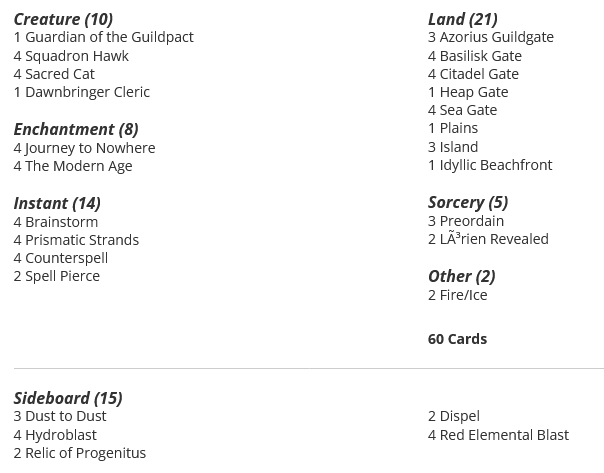
CawGate rounds out the Top 4 decks of the season thus far with six Top 8s and 8.2% of the total metagame volume. With a winner’s volume of 9.05% and an aMSAR of 0.94, it is not that far behind Boros Synthesizer and could easily overtake it before the season closes out. CawGate has a powerful core strategy and is able to supplement it with metagame specific bullets such as Fire//Ice or Cast into the Fire. The resilient nature of its win condition – namely any creature enhanced by Basilisk Gate – makes it dangerous in the late game provided it can survive that long. If the deck has any weakness it is that it has to spend time developing its mana while many of the other top strategies can sidestep this barrier.
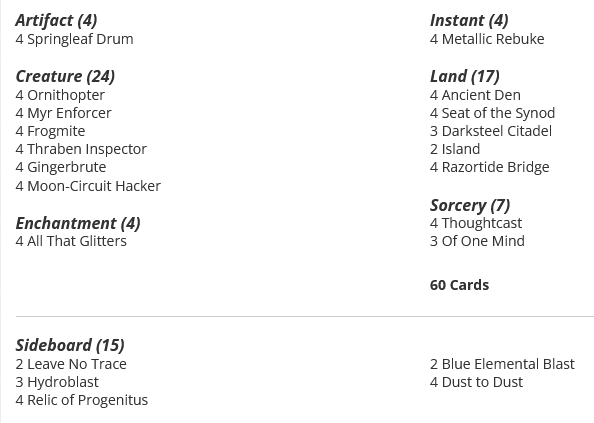
The last deck I want to focus on today is the fifth best strategy of the season: Glitter Affinity. In the same number of appearances as Boros Synthesizer it has four Top 8s but two wins. It’s adjusted volume comes in at 8.41% and it holds an aMSAR score of 0.88. Glitter Affinity is still an archetype in progress, with some opting to keep red while others focusing on black; some still run Deadly Dispute whereas certain builds lean into Reverse Engineer. The story here is less about Glitter Affinity and more how All That Glitters has pushed the archetype to be more assertive, with the more controlling Grixis Affinity taking a huge step back in popularity. Glitter Affinity is more vulnerable to removal but also is able to run narrow protective spells such as Blacksmith’s Skill. Out of all the archetypes today, this one has the most room to develop.
The decks listed above only scratch the surface with nine others topping the 2% volume threshold (Dimir Terror, Reckless Burn, Gruul Ramp, Bogles, Grixis Affinity, Izzet Terror, Black Gardens, Heroic, and Jeskai Ephemerate). The top of the meta, however, skews towards the Jeskai wedge of colors with base black showing up in Black Gardens and green centered decks popping up in the various Ramp strategies and Bogles. Black has traditionally struggled when its removal does not line up with the metagame and with a more open meta that is bound to happen. As for green, aside from accelerating out land destruction and large threats, it doesn’t really do much. Green has been eclipsed as an aggressive color and large midrange creatures don’t really cut it in competitive Pauper. Wilds of Eldraine might help the verdant cause with Troublemaker Ouphe taking on a disruptive role but even then the color has a long climb to the top.
Pauper remains in a great spot. The top of the metagame is fairly diverse with a wide variety of competitive archetypes available. Lingering just behind the top five there are several other strategies that might just need a few tweaks and tuneups before taking the next step. What’s going to happen when the format ventures into the Wilds? We won’t have to wait long to find out.
I want to take a moment to thank all my Patrons – both old and new. I am going to do my level best to keep providing you with the kind of content that brought you here in the first place. If you are interested in supporting my work, rewards for my Patreon start at just $1 and every little bit helps.
Can’t make a commitment to Patreon? I now have a Ko-Fi where you can make a one time contribution.
Looking for another way to support my work? Click here for my TCGPlayer affiliate link. Any purchases through the link let the folks there know you like my content!
 NerdtotheCore