
I use a few different metrics when looking at the Top 32 metagame. The first is just Raw Volume. The second is Win+, which takes the sum of all wins at X-2 or better in the Swiss and assigns a score; Win+ is helpful in measuring a deck’s Swiss round performance. K-Wins takes all of a deck’s wins and subtracts its losses, Top 8 inclusive; this helps to give a measure of overall performance. The final pair is call Meta Score and Meta Score Above Replacement, which takes the average of Win+ and K-Win to try and position an archetype against its field. This number helps to provide the most robust image of a deck’s performance.
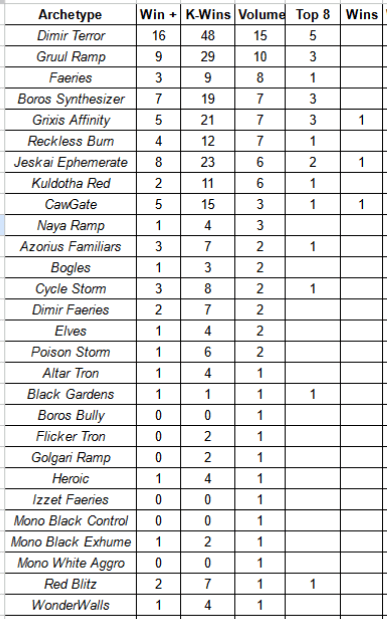
After two weeks the Lord of the Rings: Tales of Middle-earth season is starting to round into shape. The top decks from last weekend – Dimir Terror and Gruul Ramp – take full advantage of the single mana landcyclers from the latest release. These landcyclers, to paraphrase Luis Scott-Vargas from a recent episode of Limited Resources, combine the best part of running too many and too few lands. Early on these cards go and fix your mana while being a relevant spell in the latter stages of the game. In Dimir Terror the ability to go and get an Ice Tunnel or Contaminated Aquifer to turn on Snuff Out is massive as it allows the deck to apply pressure while also protecting itself from potential threats. In Gruul Ramp there are sequences with Arbor Elf that make it possible for a single Forest hand to not only hit the second land drop with Generous Ent, but also to hit Thermokarst or Mwonvuli Acid-Moss on curve, and this says nothing about potentially cascading into the Ent off of Annoyed Altisaur.
As of today, Dimir Terror is the deck to beat. It paced the field with an adjusted Meta Score Above Replacement of 1.47 over the first weekend and improved to 1.75 last weekend. This score is representative of how much better a strategy is than an average deck in the Top 32 and with these scores, Dimir Terror has shown itself to be about one and a half wins better than an “average” Top 32 deck and this bears out with an average 1.70 (a)MSAR over the first four challenges and one Showcase of the season thus far.
What does it mean to have Dimir Terror as the best deck? Like Faeries, Terror is a Counterspell strategy that wants to use its countermagic to help dictate the pace of play while also protecting key threats. Unlike Faeries, Terror is a more reactive deck, trying to set up situations where it can resolve a 5/5 at a discount in the middle stages of a game while Faeries wants to stick a small threat early to convert it into a Ninja, and as a result some new cards. Terror is less susceptible to Snuff Out and more vulnerable to Chainer’s Edict style removal while Faeries has more trouble with the sweepers in the format, as well as point removal.
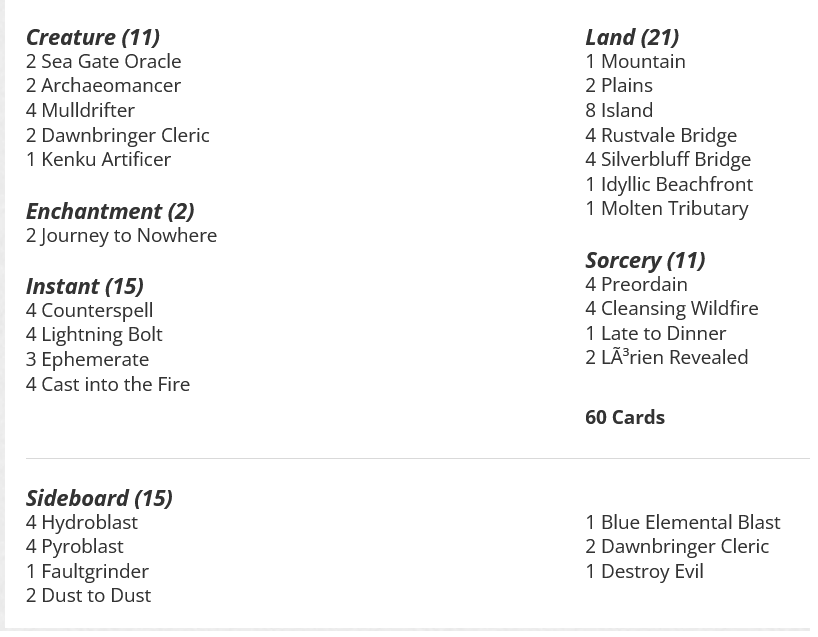
Pauper Format Panel member Mirco Ciavatta (probably better known as Heisen01) won the July 2 Challenge with this build of Jeskai Ephemerate. Jeskai Ephemerate is a solid midrange option that can adjust to most metagames and this week Mirco came prepared. With Dimir Terror and Grixis Affinity at the forefront last week, Skred was less ideal as a point removal spell. Leaning into Lórien Revealed with Idyllic Beachfront and Molten Tributary, this build has given up on the Skred package. Rather, there are maindeck copies of Cast into the Fire as a flexible answer to small threats and artifacts and Journy to Nowhere as a catch all, even if it does require additional mana to remove Tolarian Terror. Kenku Artificer can also create a never ending speed bump to hold the fort until the Ephemerate engine can take over.
After Dimir Terror and Jeskai Ephemerate, the rest of the top of the metagame is full of familiar faces. Grixis Affinity continues to be a contender, as are Gruul Ramp and Boros Synthesizer. Faeries, Kuldotha Red, and Reckless Burn are all popular strategies that are finding it a bit harder to get a foothold in the current metagame. Out of these I think Kuldotha Red is the best positioned moving forward due to how it lines up with removal. We’ve already seen Dimir Terror adjust to increased kill spells with the return of Crawl from the Cellar. Because of this, I also think that Sacred Cat strategies, whether they are Boros Bully, CawGate, or something else, are poised to have a solid showing next weekend. Sacred Cat, and the creatures that tend to surround it, line up exceptionally well with point removal, Chainer’s Edict, and cards like Cast into the Fire. The downside is that these decks also tend to lean on Basilisk Gate, making it harder (but not impossible) for them to incorporate Lórien Revealed and its ilk.
I want to take a moment to thank all my Patrons – both old and new. I am going to do my level best to keep providing you with the kind of content that brought you here in the first place. If you are interested in supporting my work, rewards for my Patreon start at just $1 and every little bit helps.
Can’t make a commitment to Patreon? I now have a Ko-Fi where you can make a one time contribution.
Looking for another way to support my work? Click here for my TCGPlayer affiliate link. Any purchases through the link let the folks there know you like my content!
 NerdtotheCore