
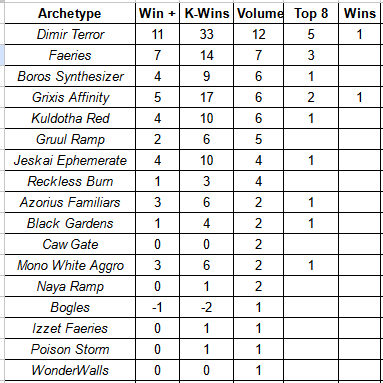
I use a few different metrics when looking at the Top 32 metagame. The first is just Raw Volume. The second is Win+, which takes the sum of all wins at X-2 or better in the Swiss and assigns a score; Win+ is helpful in measuring a deck’s Swiss round performance. K-Wins takes all of a deck’s wins and subtracts its losses, Top 8 inclusive; this helps to give a measure of overall performance. The final pair is call Meta Score and Meta Score Above Replacement, which takes the average of Win+ and K-Win to try and position an archetype against its field. This number helps to provide the most robust image of a deck’s performance.
Lord of the Rings: Tales of Middle-earth has hit Magic Online and a new season of Pauper Challeges has begun. The set has already made its presence felt with Cast into the Fire, Lembas, and Lorien Revealed (no I’m not going to try and get the exact characters) seeing heavy play. While it is hard to make any wide sweeping statements from the first week of a season there are definitely some elements of note.
First is the prevalence of Dimir Terror. A consistently good deck it is one of the better homes for Lorien Revealed as it can fix the deck’s mana early or be converted into raw cards once the game has reached a state of parity. Dimir Terror tends to have an abundance of resources in the middle and latter stages of the and the new addition provides a place to sink them. Dimir Terror averaged an adjusted MSAR of 0.55 last season and clocked in with a neat 1.47 over the weekend.
So what does this mean? The adjusted Meta Score Above Replacement – (a)MSAR – is a measure of how well an archetype did against the average Top 32 deck when taking a deck’s presence in the Top 32 into consideration. Decks with fewer entrants into the Top 32 tend to have higher unadjusted scores and this serves as a way to attempt and unskew the results. The average of all these scores over the weekend was 0.36 so Dimir Terror performed better than the average deck. Shocking, I know.
This statistic is not meant to be examined in isolation. The strategy averaged around a Top 16 finish over the weekend when looking exclusively at Swiss results, and when taking the Top 8s into account it performed at about a Top 4 clip (one win, one finals, one Top 4, two Top 8s). When taken together these metrics provide a snap shot of how Dimir Terror did in one isolated weekend.
But this is not about a singular weekend. Using these metrics we can measure a deck’s performance against itself week after week. As mentioned Dimir Terror averaged an (a)MSAR of 0.55 all of last season; in the final week it had a score of 0.02. In other words, Dimir Terror improved by nearly 1.5 Top 32 wins on average from last weekend to this weekend. When the spread from a Top 8 to a finish outside the Top 16 is often a win, that is a fairly significant jump. The top deck from the final week of March of the Machine was Grixis Affinity (1.21) which pulled in a respectable 0.58 this weekend.
Looking ahead I would not expect Dimir Terror to keep the top spot. Grixis Affinity has been a consistent force and Faeries has not gone anywhere. The various red decks have also added to their arsenal with Improvised Club. Notably absent from the Top 32 are Basilisk Gate decks, with only two all weekend. Given the number of token synergies present in the latest set I would not be shocked to see some number of Heap Gates showing up in the not too distant future.
I’m going to switch gears for a bit. Last week Daybreak, the company that manages Magic Online, announced a change to the price and prize structure of Pauper Leagues. While I am not the biggest fan of these changes (specifically at the 4 and 5 win levels) I am willing to see how things shake out. Daybreak has proved very responsive thus far and if things do not work out well I have faith the folks behind the scenes will adjust the leagues to ensure participation.
There was a common thread that showed up in many of the posts critiquing the decision that I wanted to discuss: that Pauper is somehow perceived as a lesser format. I want to pose the question as to why – why is there the perception of this perception? Why do some members of the community believe that the format is seen as lacking?
Personally I do not see this. Over the past few years Pauper has been embraced by the wider Magic community. It is on the regulars to be welcoming to those who want to test the waters and show why Pauper is enjoyable, beyond the expected value against time equation.
I want to take a moment to thank all my Patrons – both old and new. I am going to do my level best to keep providing you with the kind of content that brought you here in the first place. If you are interested in supporting my work, rewards for my Patreon start at just $1 and every little bit helps.
Can’t make a commitment to Patreon? I now have a Ko-Fi where you can make a one time contribution.
Looking for another way to support my work? Click here for my TCGPlayer affiliate link. Any purchases through the link let the folks there know you like my content!
 NerdtotheCore